
Make Space for Progress
The Power of Flexible Modularity
The core principles of flexible modularity
While traditional modularity commonly involves swapping parts within a fixed structure, our flexible modularity means the structure itself is adaptable. We build the satellite architecture around your payload, rather than forcing it into a fixed structure.
The modules themselves are flexible
This makes our architecture and design philosophy inherently tailorable: we can assemble standardised, proven modules into shapes or configurations according to specific mission objectives and capability requirements.
A flexible structure allows us to optimise designs, update technology, and improve performance throughout a mission’s lifetime - with minimised development efforts.
The design of our modules is guided by four fundamental principles:
- Decentralised architecture
- Modularity
- Redundancy
- Scalability
Together, these principles provide the robustness and flexibility needed to support complex missions, from Earth Observation (EO) and Space Domain Awareness (SDA) to Communications and Signal Intelligence (SIGINT).
Although the system is clearly divided into two main segments - the platform and the payload - the overall system architecture relies on our internally developed avionics and modules, complemented by subsystems from experienced external space industry partners.
A holistic, payload-first approach
The quality of the data products generated by the satellite depends entirely on the performance of the entire system chain. That’s why we treat the spacecraft as an integrated system from the outset, which means:
- The payload, AOCS, structure, thermal system, and operational concept are designed as a tightly coupled, cohesive system.
- Subsystems are designed and optimised for compatibility, reliability, and efficiency across mechanical, thermal, electrical and data domains.
- Plug-and-play avionics provide modular, scalable building blocks that reduce integration risk and enable software reuse.
- Interfaces are well-defined from the start, guaranteeing overall system performance and robustness.
Precision engineering & structural integrity
The main structural challenge in satellite design is ensuring the stability of the main structure while minimising micro-vibrations generated by subsystems & components like reaction wheels. We address this through rigorous mechanical engineering across materials, manufacturing, and assembly.
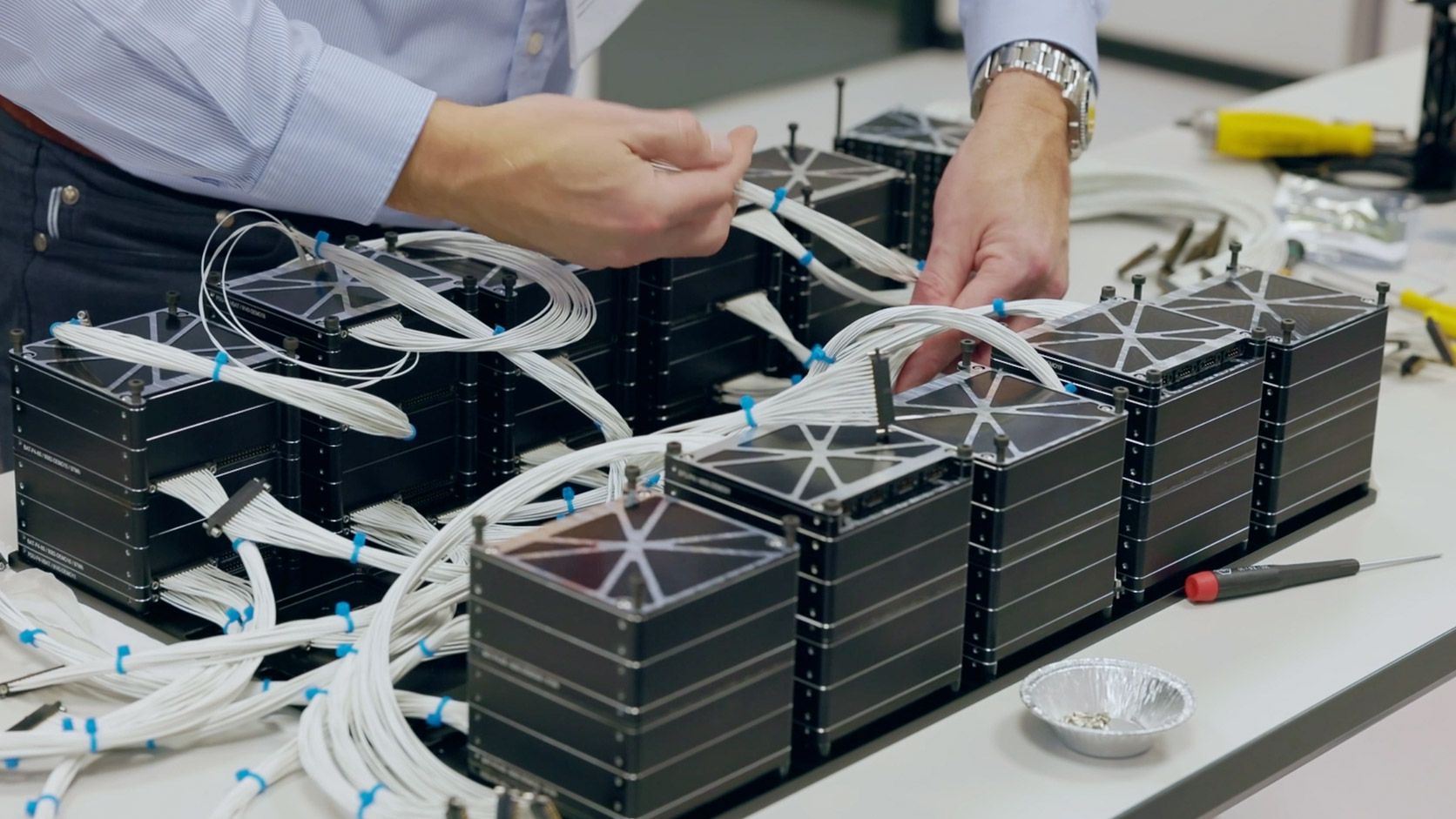
The primary structure uses high-strength aluminium, while solar panels integrated with composite materials providing high stiffness and a low coefficient of thermal expansion to minimise thermo-elastic distortions. Precision machining, combined with rigorous assembly and quality processes ensure accurate part alignment, keeping structural path errors to a minimum.
Decentralised architecture
Our architecture is organised around the platform, which operates to support all payload needs. To ensure high payload performance and accommodate ongoing technological evolution, we use a decentralised framework - a network of nodes communicating over redundant CAN buses, rather than a single onboard computer controlling all subsystems.
We also implement the CSP 2.0 protocol, a parameter-based system that allows any node to communicate with any other node on the network. This significantly reduces the single points of failure typically associated with centralised architectures.
Uncompromising redundancy & reliability
Redundancy is a fundamental principle of all of our components and mission designs, to ensure robustness and maximise overall system reliability.
Using a multi-layered redundancy strategy ensures you have a highly resilient spacecraft that’s capable of maintaining functionality even in the presence of failures.
Component-level redundancy
- Space Inventor’s P4 module family features inherently embedded hardware redundancy.
- All modules feature dual CAN communication interfaces and dual power interfaces.
- Critical subsystems - including Power Distribution Units (PDUs), Maximum Power Point Trackers (MPPTs), Inertial Measurement Units (IMUs), On-Board Computers (OBCs), and magnetorquers – incorporate multiple fully independent microprocessors.
- The OBC-P4 integrates four independent and redundant processors within a single board, significantly enhancing fault tolerance.
System-level redundancy
- For components that do not include intrinsic redundant interfaces, redundancy is achieved by adding parallel units.
- This system-level redundancy applies to both Space Inventor avionics and externally supplied subsystems.
- For subsystems equipped with only a single CAN interface, such as Fine Sun Sensors (FSS), multiple sensors are installed with overlapping fields of view and distributed across both CAN buses.
Resilient power and communications
Reliability isn’t just a design goal - it’s an engineering imperative that runs through every power and communications decision we make.
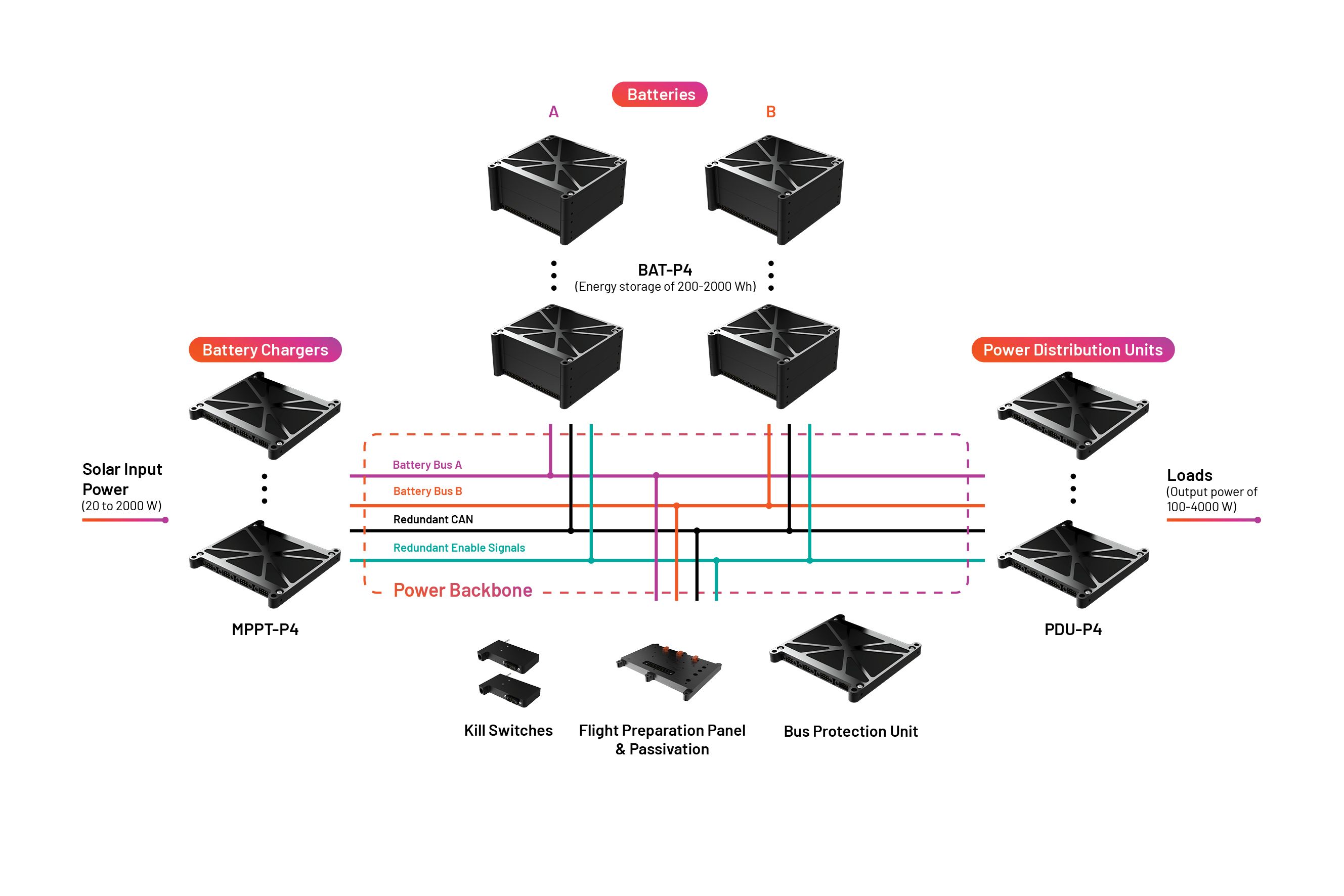
The electrical power subsystem is built around a battery backbone architecture with two fully redundant power buses, each connected to all key power elements and sharing the battery pack equally. If one power bus fails, the other can maintain spacecraft survival and essential operations.
Sitting within that subsystem, the Bus Protection Unit (BPU): adds a further layer of fault recovery: it can perform a full power cycle of the spacecraft bus via a dedicated firecode command from the ground. This serves as an additional mechanism for Fault Detection, Isolation, and Recovery (FDIR) to address anomalies that cannot be resolved at the module level. It also protects the CAN bus against voltage spikes through Transient-Voltage-Suppression (TVS) diodes.
The same redundancy logic runs through communications. A dual CAN bus architecture transmits all commands and telemetry simultaneously across both buses, eliminating the need for reconfiguration if a single bus fails.
The Telemetry, Tracking and Command (TMTC) system uses primary and secondary radios with redundant CAN interfaces, up to 64 GB of onboard mass storage, and support for RS422, LVDS, and SpaceWire. Nadir-pointing antennas provide S-band redundancy, while additional antennas oriented in different directions guarantee communications during early operations and the detumbling phase.
Your payload defines the platform. We make it fly.
Ultimately, flexible modularity is more than an engineering principle - it is our commitment to ensuring your payload reaches its absolute full potential.
By combining the speed, cost-efficiency, and reliability of standardised, flight-proven modules with the geometric freedom of a custom build, we eliminate the need for compromise. Your mission parameters define the architecture; we provide the power, precision, and resilience to make it a reality. 
Partner with Space Inventor to configure a highly capable, sovereign platform that serves your exact operational, scientific, or tactical objectives. [Contact our mission engineers today], and together, let's Make Space for Progress.
Popular articles