
Mini Constellations: The Small-Batch Advantage
More of our missions today are focused not on a single satellite, but rather a cooperative architecture of multiple spacecraft designed to achieve specific, complex goals. We call them mini constellations, and they are ushering in a new era of agile, responsive space missions.
At Space Inventor, we build and deliver these smaller fleets of payload-centric satellites in rapid, evolving batches. This approach keeps the technology current, spreads cost and risk over time - and gets satellites into orbit sooner.
We call it the small-batch advantage
Small-batch delivery means building and launching a constellation in stages. Instead of completing a whole constellation in one go, the first batch of satellites is launched and operating while the next is still being built.
This offers three distinct advantages to modern constellation missions: each batch can carry the latest payload technology, cost and risk are spread over time,and the fleet reaches orbit sooner.
1. Continuous evolution
Payload technology is continuously evolving. When a whole constellation is designed and then built in one go, every satellite in it carries the sensors that were available at the start of the programme, and by the time the last one launches, those sensors can be several years old.
Delivering in batches solves that. The first batch flies with the best payload available at the time. The second flies with a better one (informed by what the first batch learned in orbit) and by the third batch, the fleet may be carrying tech that didn’t even exist when the programme first began.
2. Cost-effective speed
If a whole constellation is built before any of it launches, the customer pays for years of work before a single satellite can send any data back. Small-batch delivery spreads that commitment out. Less money is at risk at the start - and the return on it begins earlier. Commercial operators get data sooner and defence customers get capability sooner.
3. Accelerated time to orbit
Delivering in small batches means the first satellites can launch as soon as they are ready, rather than waiting for the whole fleet to be finished. Launch timelines move forward, and the mission starts returning data sooner.
It also makes changing requirements much easier to handle. If the mission’s needs change part-way through, the next batch can be built to meet them, while the satellites already built carry on to launch as planned.
That way, a mission never gets stuck at the starting line.
What makes small-batch delivery possible?
Delivering a fleet in batches only works if each batch arrives on time and performs like the ones before it. That depends on control over quality and timeline - which is why we build with deep vertical integration.
Flexible Modulatory
We combine standardised, flight-proven modules with customisation around each payload. Standardisation keeps a mini constellation consistent from the first satellite to the last. Customisation around each payload keeps every satellite fit for its job.
Engines of Progress
Our in-house, modular power, control, and communications technologies provide the foundational, flight-proven building blocks that make our Flexible Modularity possible.
Built in Denmark
With all-in-house production based in Denmark, we control the timeline and the quality, effectively bypassing third-party supply chain delays.
Built to scale
Our BIG CAT platforms are flight-proven and adapt to mission requirements, so a fleet can grow from a single satellite to a dedicated mini constellation. Our Apex Predators are turnkey, fleet-ready satellites built for rapid deployment and high-performance surveillance.
The Baltic Sea model: a small-batch constellation in action
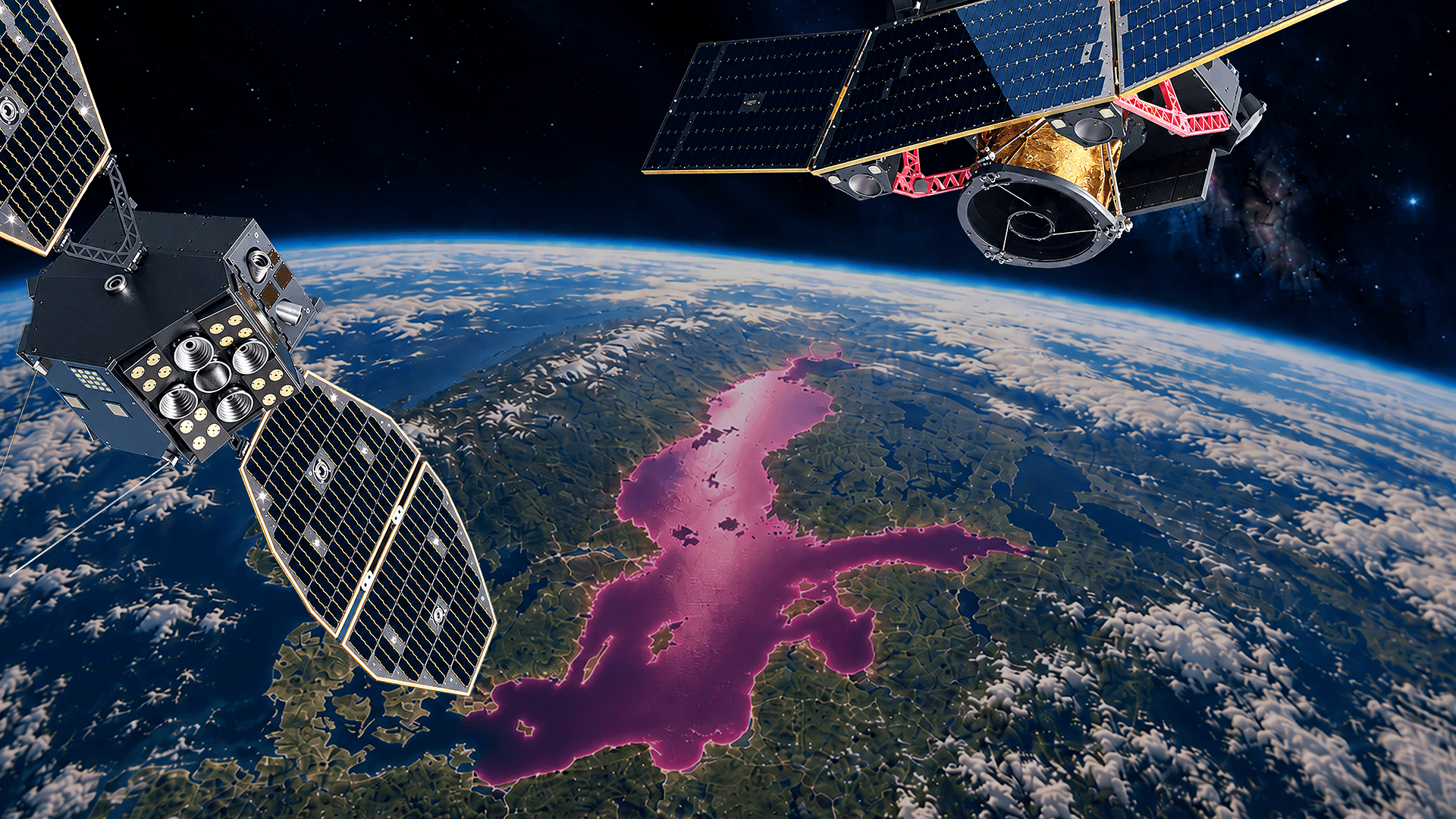
Our Baltic Sea model shows how a mini constellation can grow in batches. It pairs two satellite types from our Apex Predators range, both built on our BIG CAT platforms:
BC Lynx detects radio frequency signals from vessels across a wide area
BC Leopard captures a sub-metre optical image of whatever BC Lynx finds
Detection to image takes just 14 minutes, whatever the size of the fleet. Adding satellites will increase how often the region is checked:
| Satellites | Daily looks | Detection to image |
|---|---|---|
| 1 BC Lynx + 1 BC Leopard | > 6 | 14 min |
| 8 BC Lynx + 8 BC Leopards | > 40 | |
| 16 BC Lynx + 16 BC Leopards | > 75 | |
| Detection to image is the time between an initial RF detection by BC Lynx and optical identification by BC Leopard, whatever the size of the fleet. | ||
A customer could start with a single pair and add more as their coverage needs grow, with later batches carrying newer sensors.
Built around the mission, delivered in batches
Small enough to be built around the needs of the mission. Large enough to deliver the coverage that a single spacecraft can’t. Whatever the mission, the approach is the same: a fleet built around its payloads and delivered in small, repeatable batches, so it can launch sooner, carry the latest technology, and grow with the mission.
Popular articles