
Space Inventor selected to build satellite for Denmark’s first lunar mission
A milestone in Danish space history: Space Inventor selected to build satellite for Denmark’s first lunar mission
The Danish government has announced that it is allocating DKK 130 million (approx. 19 million USD) to Denmark’s first satellite mission to the Moon. The satellite will be developed and built by Space Inventor in Aalborg and will become Denmark’s most ambitious space instrument to date for lunar science and monitoring. ESA is currently conducting the final approval process for the project.
Aalborg, 2 December, 2025 – The Danish government is now moving forward with plans to send a Danish satellite to the Moon as part of its new national space strategy. With a budget of DKK 130 million, equivalent to 19 million USD, Space Inventor in Aalborg is expected to design and build the satellite, which will study the lunar surface and environment as part of national and international scientific collaboration.
If the European Space Agency (ESA) approves the Máni mission in December, the satellite is expected to launch toward the end of the decade. According to Denmark’s Minister for Higher Education and Science, Christina Egelund, the mission marks a historic shift in Danish space capabilities.
- The Danish government prioritizes space because it has real impact on life here on Earth. It is a major triumph that we are now one step closer to a Danish-led lunar mission. The Máni mission can provide new insights into the lunar surface while simultaneously strengthening the Danish space sector and its research capabilities. It reinforces Denmark’s position as an ambitious and technologically strong space nation capable of developing and executing its own advanced missions. It gives Denmark greater influence within European space initiatives and better opportunities to shape the future of space technology, the minister says.
A milestone for Space Inventor and for Denmark
For Space Inventor, the lunar mission represents a technological and strategic breakthrough.
- Denmark preparing to send a satellite to the Moon is a historic moment for Danish spaceflight, says Karl Kaas, Founder & CEO of Space Inventor.
- We have already developed advanced satellites for Arctic monitoring and international science missions, but being entrusted with Denmark’s first lunar mission is something truly special. It is a responsibility we are proud to take on, says Karl Kaas.
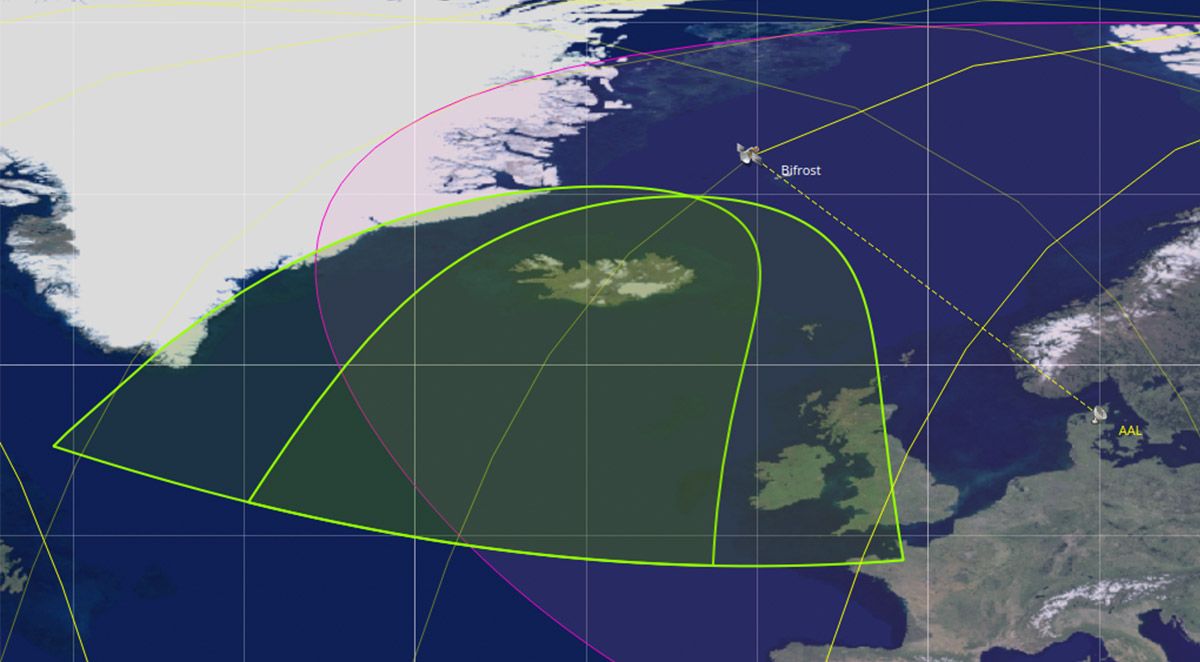
The satellite will be based on Space Inventor’s proprietary microsatellite platform, the same core architecture used for the BIFROST mission launched in 2025 for Arctic surveillance. The platform will be equipped with specialized instruments for lunar science, navigation, and data acquisition in the challenging lunar environment, where extreme temperatures, radiation, and distance impose entirely new demands on robustness and autonomous onboard intelligence.
- This is not just a satellite launch. It is technology that must operate reliably in an extreme environment 400,000 kilometers from Earth. Our experience with advanced sensors and satellite autonomy will be absolutely essential, says Peter Davidsen, CTO of Space Inventor.
New scientific opportunities for Denmark
The Danish government highlights the lunar mission as a key component of Denmark’s growing engagement in international space research. The mission aligns with the increasing global interest in the Moon as a scientific and resource target.
- For many years, we have worked to give Denmark a stronger role in international space research. Denmark can — and should — contribute more in space, both technologically and scientifically. If ESA gives its final approval, it will reflect a new level of confidence in Denmark as a true spacefaring nation, says Karl Kaas.
Space Inventor expects the mission to accelerate the development of new Danish technologies for deep-space navigation, lunar orbit insertion, and satellite operations during imaging and data collection. Danish universities, research institutions and industrial partners will be involved as the final mission architecture is shaped.
The upcoming lunar mission builds directly on the space strategy presented by the Danish government in 2024, which also formed the foundation for the BIFROST satellite developed by Space Inventor. While BIFROST strengthens Denmark’s capabilities in Arctic monitoring, the Máni mission represents a new level of ambition — and a technological leap further into deep space. Denmark’s increased contribution to ESA makes it possible for the agency to greenlight the Danish-led lunar mission.
For further information, please contact:
Peter Davidsen, CTO, Space Inventor A/S
+45 28 22 02 51 / peter.davidsen@space-inventor.com
Karl Kaas, Founder & CEO, Space Inventor A/S
+45 31 20 82 10 / karl@space-inventor.com
Press enquiries:
Jacob Lange, Lange PR
+45 20 76 30 20 / jacob@langepr.dk
Popular articles